

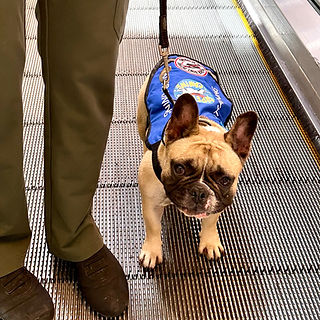

What is an Assistance Dog?
Assistance Dogs
An assistance dog is a specially trained dog that supports an individual with disabilities to perform daily tasks and live more independently. These dogs are carefully selected for their temperament, intelligence, and willingness to work, they are trained to reliably assist with a wide range of needs, including mobility, psychiatric, neurological, and other disabilities.
Assistance dogs may help their handlers navigate obstacles, retrieve items, open doors, alert to important sounds or changes in their handler’s behaviour, and provide grounding and emotional support when required. Their training focuses on calm, confident behaviour in public spaces and dependable task work tailored to the handler’s specific needs.
Types of assistance dogs can include guide dogs for people with vision impairment, hearing dogs for people who are deaf or hard of hearing, and assistance dogs that assist with mobility, psychiatric conditions and an array of other diagnosed disabilities. These dogs play a vital role in improving safety, independence, and overall quality of life, while also providing trusted companionship.
In Australia, the recognised term is assistance dog, which is interchangeable with service dog, the term more commonly used in the United States.
At Super Canine Assistance Dogs, we specialise exclusively in training assistance dogs for a wide range of disabilities. We do not train guide dogs or hearing dogs. We work with clients who require task-trained assistance dogs for physical, psychiatric, neurological, and other disabilities.

GHAD Certification
Guide, Hearing & Assistance Dogs Queensland (GHAD QLD) is the statutory certification system established under Queensland’s Guide, Hearing and Assistance Dogs Act 2009 to regulate and accredit assistance dog teams. It provides legally recognised ID cards and badges and protects a handler’s right to access public places, transport and accommodation with their certified dog. GHAD offers a government-backed, enforceable standard, making it widely regarded as the gold standard for assistance dog accreditation in Australia.
Gold Standard Certification
Stringent Certification Standards
Dogs must pass a rigorous Public Access Test (PAT) conducted by approved trainers to demonstrate safe access to public spaces, transport and accommodation.
Extensive Skill Development
Training involves the structured development of specialised skills over an extended period to ensure the dog can reliably perform clearly identifiable tasks that mitigate a person’s disability.
Positive Reinforcement Focus
Training uses reward-based methods that prioritise welfare while building reliability and motivation to work.
Comprehensive Public Safety
Training involves the structured development of specialised skills over an extended period to ensure the dog can reliably perform clearly identifiable tasks that mitigate a person’s disability.
Legal Recognition
Certification provides legal protection under Australian law, supporting a handler’s right to access public places with their assistance dog.
Assistance Dog Overview
In Australia an Assistance dog is defined as a dog that has been individually trained to do work or perform tasks for an individual with a disability. The tasks performed by the dog must directly relate to the person's disability.
While performing its role as an assistance dog, it should adhere to proper standards, including:
-
Being clean, well-groomed, and free of offensive odours.
-
Not urinating or defecating in inappropriate locations.
-
Must be harnessed, leashed, or tethered to the handler while in public places.
-
Should be responsive to the first command of the handler 90% of the time.
-
Not soliciting attention, visiting, or annoying any member of the general public.
-
Not disrupting the normal course of business.
-
Not vocalising unnecessarily, such as barking, growling, or whining. However, some assistance dogs are trained to give a notification bark to their owner in case of an impending medical emergency.
-
Showing no aggression towards people or other animals.
-
Not begging or stealing food or other items in public.
-
Working calmly and quietly on a harness, leash, or other tether.
-
Being able to perform its tasks in public despite multiple distractions.
-
Must be able to lie quietly beside the handler without blocking aisles, doorways, etc.
-
Stays within 60 cm of its handler unless the nature of a trained task requires it to work at a greater distance.
-
Keeping all four paws on the ground, unless completing a specific task to aid the handler.
