
Balancing exercise and sleep
Do you have a dog who needs to become calmer?
Is your dog an adrenaline junkie?
Do you struggle to walk him on a leash and keep him from jumping up?

Chances are that your dog has too many high-impact activities or does not get enough rest
throughout the day.
Unfortunately, there are two extremes when it comes to exercising dogs.
1. We have dogs that obviously do not receive sufficient mental and physical stimulation and challenges. These dogs are bored, destructive, often over-weight, engage in behaviours like excessive digging or shadow chasing and
would certainly do a lot better if they had more activities with their owner.
2. Then the dogs that do have plenty, if not too much, physical exercise, as the owners have believed this is the only way to keep the dog’s behaviour under control. If you feel like your dog is going to bounce off the walls if he doesn’t get his daily 3km run. This article is for you.
A tired dog is a good dog?
We all have heard the phrase “a tired dog is a good dog” time and time again.
A dog that fell asleep exhausted won’t get into trouble for chewing your furniture or barking at the door. Physical exhaustion is not a prerequisite for being well behaved. Dogs can be well behaved, happy, and satisfied without the need for excessive physical exercise.
If your dog cannot behave appropriately without being completely worn, the answer is not to increase his physical exercise.
If you are always chasing the next rest time that comes after wearing out your dog, you are in for a difficult ride.
The danger of creating super Athletes
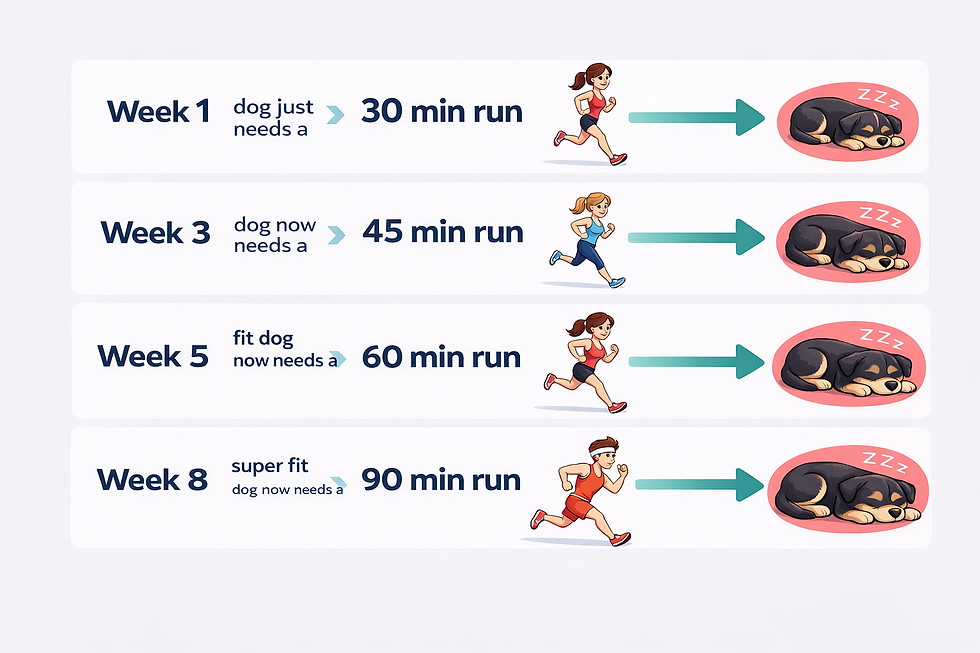
Dogs are very physically capable, especially working dogs such as border collies and kelpies. If you increase their exercise, they will adapt with increased endurance and fitness. Unfortunately, they are a lot better at getting fit than most people, they will most certainly build fitness a lot quicker than you.
Puppies will tire quickly but as they develop into adolescence and beyond it will get much harder to wear them out with physical exercise.
You cannot realistically manage your dog’s behaviour solely by trying to “tire him out” every day.
Adrenaline creates restlessness
After high-intensity activities like playing fetch or running with other dogs, he can be "hyped up" and more restless.While physical activity is important, it does NOT need to be wild and intense every time.
Dogs need regular rest to behave and feel well
Dogs are not made to stay awake many hours of the day. They require regular sleep or rest time.Many high-energy dogs do not put themselves down for a sleep, they need us to provide those sleep times
An exhausted dog can be a grumpy dog
Being overly tired increases reactive and demanding behaviour and that makes dogs more likely to be grumpy or misbehave.
Balancing physical and mental activities
Activities that require the dog to think and problem-solve can wear dogs out much more than purely physical exercise. Especially dogs that are used to instant gratification, that are intense and energetic or dogs that love to chase and be crazy. These dogs are very quickly and effectively tired out by presenting them with challenges that require them to think.
Simply standing still can be one of the most effective ways to wear out a dog that is highly strung. An excellent activity to do with your dog is to take him to a busy outdoor shopping mall, a park or similar and simply stand there and reward the dog for being handler focused, for staying calm or laying down. This can be very challenging for a lot of dogs and is mentally exhausting. Being calm in public is a great activity that will get your dog tired without high-impact physical exercise.
Working on skills and tasks that are low energy but require the dog to think, problem solve or make controlled and thoughtful movements can be just as tiring as having him fetch a ball for 30 minutes.
Examples include:
· Shaping exercises such as light touch
· Sniffing exercises such as find the treats under the cones or hidden somewhere
· Food scatter
· Noseworks basics
· Fill a water bottle will a few treats and let the dog work out how to get them out
· In summer freeze toys and treats in blocks of ice
Engaging your dog in thoughtful activities that challenge his mind, not just his muscles, will be a beneficial addition to his daily schedule.
Give your dog a chance to calm down
If your dog is always in motion, always doing something how can he relax?It sounds counter-intuitive, but the key to managing high excitement can be to not tire out your dog as much.
1. Try out a sniffing game instead of a frantic game of fetch
2. Ensure that your dog takes at least 2-3 sleeps a day, crate training will be of great benefit
3. Alternate high-excitement activities with calm thinking games
If your dog has constant access to a large yard or property you may need to put him into a smaller area to ensure he rests instead of running around all day without a break.
The importance of sleep
Proper sleep is a pillar of your dog's wellbeing and of successful training. If you have a dog who is not well-rested, you won't ever reach their full potential in training, along with a host of other issues.
Dogs need 16-20 hours of sleep a day. But it's not enough for this to be in one chunk, they need rest times as well. A dog who has been awake for more than 3-4 hours will not be the happiest and most well-behaved dog. Like toddlers, they become cranky and grumpy and don't really know what to do with themselves and they cannot focus and learn well.
Even if you already have a good sleep schedule going for your dog, make sure there is enough time to rest on unusually busy days. Family get-togethers are a great example for this. Your dog might be really excited to have so many friends over, and he will not be able to put himself down for a rest when there is so much going on. This can even result in dogs eventually becoming a bit snarly as they were overly tired and didn't have time to wind down and relax.If you have a busy day, make sure your dog gets to sleep after about 3-4 hours of activity.This can mean actually putting them into a safe space by themselves, such as a crate, with a nice chew while you and your visitors stay in the yard or in another area of the house. This is especially common in puppies. The difference between training a puppy who is well-rested and one that is tired and cranky is massive.
If your dog is struggling with behavioural issues, I guarantee these will get worse if they don't have enough rest. Of course, it doesn't mean that once your dog sleeps enough all their problems will magically disappear without any training but rather, that enough sleep is a prerequisite to successful behaviour modification.
Leanne Hoogwerf
Comments